CAMPAIGN TIME
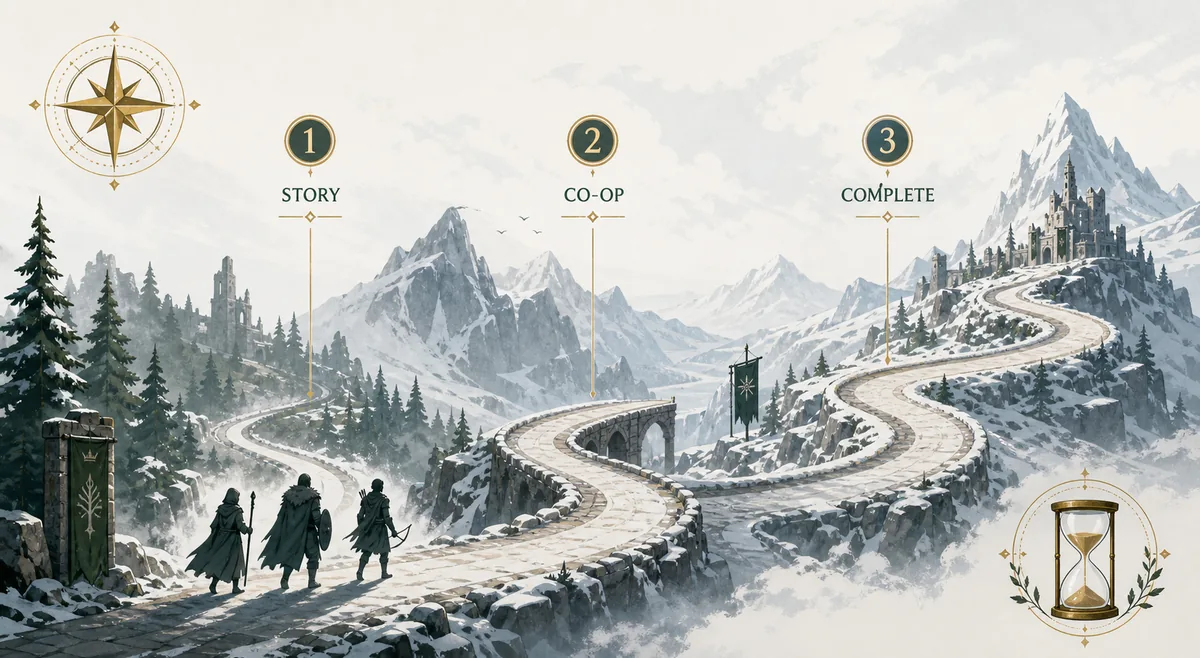
Short answer: plan roughly 10-15 hours for a focused first story run, 15-20 hours for a normal co-op run with retries, and 20-30+ hours if you explore heavily or work through completion checklists. These are editorial planning ranges, not an official average or a live player-data claim. Your route, difficulty, party, and tolerance for retries matter more than a single clock number.
The quick estimate
If you searched how long to beat War in the North because you are arranging a weekend or a new co-op save, use the ranges above as a calendar aid. A focused run keeps moving through the story and does not stop for every optional sweep. A normal group run includes pauses, retries, role changes, and time spent deciding what to do next. Completion-focused play adds another layer of searching and revisiting.
What each range actually includes
The first range is for a player who follows the main route and accepts a few imperfect encounters. The middle range is a more realistic plan for three people learning the rhythm together. The longest range is not a promise that every player needs 30 hours; it is a reminder that collectibles, achievements, missed objectives, and repeated attempts change the shape of a campaign. Treat the table as a planning model, not a leaderboard.
Focused story run
A story-first session is the shortest reasonable way to approach the game. Keep one player responsible for the next objective, avoid splitting the party to chase every corner, and mark uncertain discoveries for later. This does not mean rushing or skipping every optional moment. It means protecting the main rhythm so one missed note does not turn into a full restart. The walkthrough page is useful when you want a compact route without carrying a full map into the session.
Co-op adds coordination time
War in the North is built around a three-hero party, so co-op length is shaped by people as much as by levels. Allow time for choosing classes, explaining roles, recovering after a wipe, and waiting when one player needs to read a situation. The official Steam listing confirms the PC product context and co-op category, but it does not publish a standard completion time. Use the party planner and co-op guide to reduce avoidable pauses rather than treating a faster run as automatically better.
Exploration and completion take longer
The campaign becomes a longer project when you search side spaces, compare equipment, revisit missed objectives, or keep separate achievement goals. A local checklist helps because it turns memory into a visible next step. Use it after a combat space is safe, not while the party is still under pressure. For a completion-minded run, leave room for a second pass and accept that some community notes may need confirmation in your own release.
A low-friction way to plan each session
Choose one goal before launching: finish the next story section, check a small exploration area, or protect time for a co-op retry. Assign a simple caller for the next objective, keep the support player close to an exit, and write down what was confirmed. When the session ends, mark the route instead of relying on memory. This keeps the playtime estimate useful even when the group takes a different path from the first plan.
Why your result may differ
The range changes with difficulty, controller familiarity, party size, retries, exploration habits, and whether everyone is reading or watching the same clues. An experienced solo player may move faster through known rooms, while a first co-op group may spend more time learning safe spacing. Hardware, storefront status, and old-release differences can affect access, but they should not be converted into a made-up runtime. Record your own route if you need a repeatable estimate.
What this guide can and cannot verify
There is no official Steam playtime figure attached to the product metadata used here, and this site does not claim a live database average. The ranges are a transparent editorial estimate designed to answer a planning question. Use the official Steam page for current product and platform context, then use the walkthrough, checklists, and co-op pages for the route you actually intend to play. If your own timing differs, that is useful evidence for a future update rather than a contradiction.
Answer the immediate question first
The War in the North playtime page is arranged for a player who has a decision in front of them, not for someone collecting trivia. Read the opening answer, identify the condition that could change it, and then use the linked route that handles the next action. This order keeps a quick lookup useful while still making the evidence and limits visible. It also prevents a historical platform fact, a community observation, and an editorial recommendation from being mistaken for the same kind of claim.
Turn the note into a session plan
Before a chapter begins, choose one small outcome from the War in the North playtime page. A group might assign a role, check one route, confirm one platform detail, or mark one objective. Write the decision in plain language so every player can react to the same plan. If the room changes, keep the decision reversible: pause, regroup, and change the next step instead of treating an early guess as a permanent build or promise.
Separate facts from useful interpretation
Some details on War in the North playtime come from official store or platform material, while others are practical reading of the game's co-op rhythm. The page keeps those categories distinct because they age differently. Official metadata is the right place to confirm product status; a role suggestion is a starting point that should be tested in your own party. When the source does not answer a question, the copy says so rather than filling the gap with a confident invention.
Use comparisons with a clear purpose
A comparison is valuable only when it changes what a player does next. On War in the North playtime, compare options by the problem they solve: space, recovery, interruption, exploration time, or technical risk. A larger number or a familiar label is not automatically better. Note the platform, difficulty, party size, and current objective before deciding. That context explains why two players can make different choices and both be following a sensible plan.
Recover from an imperfect run
A first attempt does not need to be perfect to be useful. If the War in the North playtime page points to a missed objective or an unclear platform detail, record it as provisional and continue with the safe part of the route. Co-op groups lose time when they restart from a vague memory. A short note, a screenshot from the game, or the exact store wording gives the next run something concrete to verify.
Know when the guide stops
This companion does not replace the game, host unauthorized files, or promise that an older release is available in every region. The War in the North playtime page stops at the point where a reader needs the official store, platform holder, or their own in-game record. That boundary is deliberate: it keeps the guide useful without pretending to control pricing, catalog changes, account state, controller drivers, or community discoveries that the site cannot independently guarantee.
Check the version-sensitive details
Older releases can differ because of region, hardware, storefront rules, patches, input devices, and the condition of a second-hand copy. When War in the North playtime depends on one of those variables, confirm it immediately before spending money or changing a working setup. Treat a community note as a lead, not as an official statistic. The source ledger records the first-party material used here so a later update can replace a stale assumption instead of silently carrying it forward.
Continue through the related routes
The most useful path is usually short: open War in the North playtime, take one action, then move to the Party Planner, Classes, Co-op Guide, or the relevant checklist. Those pages are linked so a reader can keep the same language and locale while moving from discovery to execution. When the goal is completion, pair the Walkthrough with Collectibles and Achievements. When the goal is a stable first session, start with one class per role and use the PC Fixes page only for reversible checks.
War in the North playtime planning ranges
| Goal | Planning range | What changes the clock |
|---|---|---|
| Focused story run | About 10-15 hours | Main route, few detours, limited retries, familiar controls. |
| Normal three-player co-op | About 15-20 hours | Role setup, pauses, retries, reading situations, and regrouping. |
| Exploration or completion focus | About 20-30+ hours | Side sweeps, missed objectives, collectibles, achievements, and revisits. |
How to keep a run on schedule
1. Pick the session goal
Decide whether the next session is story progress, a co-op retry, or a short exploration sweep. One goal keeps the estimate meaningful.
2. Keep one route visible
Use the walkthrough for the next campaign note and avoid opening several competing checklists while the group is moving.
3. Mark confirmed progress
Use the local checklists after the room is safe. Mark only what you actually confirmed so the next session starts with a useful record.
4. Separate timing from troubleshooting
If PC or controller issues appear, record them as a separate delay. Do not turn one technical problem into a false claim about the game campaign length.
War in the North playtime FAQ
How long to beat War in the North for the story only?
Use about 10-15 hours as a practical first-run planning range for a focused story route. It is an editorial estimate, not an official Steam statistic, and retries or unfamiliar controls can move it.
How long does a three-player co-op run take?
Plan about 15-20 hours for a normal group run that includes class choices, pauses, failed encounters, and regrouping. A coordinated group can be faster; a first run can take longer.
Does difficulty change War in the North playtime?
It can. Higher pressure often adds retries and slower room checks, while a familiar group may offset some of that time. Treat difficulty as one planning variable rather than a fixed multiplier.
Can a completionist run take more than 20 hours?
Yes. Searching side spaces, revisiting missed objectives, comparing equipment, and checking achievements can push a run beyond the story-first range. The 20-30+ hour band is intentionally open-ended.
Is this an official HowLongToBeat average?
No. The official Steam source confirms product and co-op context but does not publish a standard completion time here. This page separates verified store facts from a transparent editorial planning estimate.
Sources and limits
The official Steam page is used for product, platform, co-op category, and official media context. It is not presented as a runtime source. The ranges on this page are editorial planning estimates, so they should not be read as official or universal measurements.
- Official Steam store pageFirst-party product metadata, platform context, co-op category, and hosted media.